Vissen in de Seine (1)
met Hemingway en Orwell
George Orwell, Down and Out in Paris and London
My money oozed away – to eight francs, to four francs, to one franc, to twenty-five centimes; and twenty-five centimes is useless, for it will buy nothing except a newspaper. We went several days on dry bread, and then I was two and a half days with nothing to eat whatever. This was an ugly experience. There are people who do fasting cures of three weeks or more, and they say that fasting is quite pleasant after the fourth day; I do not know, never having gone beyond the third day. Probably it seems different when one is doing it voluntarily and is not underfed at the start.
The first day, too inert to look for work, I borrowed a rod and went fishing in the Seine, baiting with bluebottles. I hoped to catch enough for a meal, but of course I did not. The Seine is full of dace¹, but they grew cunning during the siege of Paris, and none of them has been caught since, except in nets.
Ernest Hemingway, A Moveable Feast
I knew several of the men who fished the fruitful parts of the Seine between the Île St-Louis and the Place du Verte Galente and sometimes, if the day was bright, I would buy a liter of wine and a piece of bread and some sausage and sit in the sun and read one of the books I had bought and watch the fishing.
Travel writers wrote about the men fishing in the Seine as though they were crazy and never caught anything; but it was serious and productive fishing. Most of the fishermen were men who had small pensions, which they did not know then would become worthless with inflation, or keen fishermen who fished on their days or half-days off from work. There was better fishing at Charenton, where the Marne came into the Seine, and on either side of Paris, but there was very good fishing in Paris itself. I did not fish because I did not have the tackle and I preferred to save my money to fish in Spain.
Vissen in de Seine (2)
met Steen, Potter en P.C. Hooft
Grappig is dat het vraagstuk ‘Vis in de Seine?’ ook opduikt in Parijse feesten, de autobiografische verhalenbundel van Ethel Portnoy (1927-2004) over de tijd, de jaren vijftig, dat ze samen met haar man, de schrijver-essayist Rudy Kousbroek, in Parijs woonde. In het verhaal ‘Waarover praten kunstenaars?’ beschrijft ze een avondje bij de Corneilles: Corneille en de fotografe Henny Riemens. Corneille heet in dit verhaal ‘Jan Steen’, Kousbroek ‘P.C. Hooft’. Van de partij was ook ‘Paulus Potter’, lees de Amsterdamse kunstenaar Frank Lodeizen. Zodra ze thuiskwam heeft Ethel ‘Maria Tesselschade’ Portnoy een gespreksverslag gemaakt, genotuleerd met vertraging als het ware, dat ze vele jaren later terugvond.
Waarover spraken zij, die vijf daar in Parijs? Nou, ook over vissen in de Seine.
Paulus Potter zei dat hij eens moest opstappen. Zijn bestemming kwam aan de orde. Hij logeerde in een dorp aan de Marne. Paulus verklaarde dat ofschoon hij veel mensen in de Seine zag vissen hij nooit iemand wat zag vangen.
Daarentegen zei Jan Steen dat hij ze massa’s kleine visjes had zien vangen, ietsje groter dan sardientjes, die gebakken erg lekker waren.
Pieter Corneliszoon, Paulus Potter en Jan Steen raakten toen in discussie over de vraag of de Seine dan wel de Marne het schoonst was. Zij kwamen niet tot een definitief oordeel.
Paulus Potter vertrok, en Pieter Corneliszoon en Maria bleven achter met Jan Steen en Judith [Leyster]. Het gesprek stokte en de vier zaten nog wat bij elkaar, verzonken in hun eigen gedachten.
“They were delicious fried whole and I could eat a plateful.”
Friture de petits poissons
Corneille zei dat hij de vissers bij de Seine “massa’s kleine visjes had zien vangen, ietsje groter dan sardientjes, die gebakken erg lekker waren.”
Terug naar Hemingway, A Moveable Feast, hoofdstuk 4: ‘People of the Seine’.
At the head of the Île the la Cité below the Pont Neuf where there was the statue of Henri Quatre, the Island ended in a point like the sharp bow of a ship and there was a small park at the water’s edge with fine chestnut trees, some huge and spreading, and in the currents and back waters that the Seine made flowing past, there were excellent places to fish. You went down a stairway to the park and watched the fishermen there and under the great bridge. The good spots to fish changed with the height of the river and the fishermen used long, jointed, cane poles but fished with very fine leaders and light gear and quill floats and baited the piece of water that they fished expertly. They always caught some fish, and often they made excellent catches of the dace-like fish that were called goujon. They were delicious fried whole and I could eat a plateful. They were plump and sweet-fleshed with a finer flavor than fresh sardines even, and were not at all oily, and we ate them bones and all.
One of the best places to eat them was an open-air restaurant built out over the river at Bas Meudon where we would go when we had money for a trip away from our quarter. It was called La Pêche Miraculeuse and had a splendid white wine that was a sort of Muscadet. It was a place out of a Maupassant story with a view over the river as Sisley had painted it. You did not have to go that far to eat goujon. You could get a very good friture on the Île St.-Louis.
Goujon is de Franse naam voor de riviergrondel (Gobio gobio), een bodemvisje dat behoort tot de familie van de karperachtigen (Cyprinidae) en herkenbaar is aan de twee tastdraden bij zijn bek. De visjes werden met graat en al gebakken, schrijft Hemingway, en blijkbaar net als frites ‘in bulk’ gegeten, vast en zeker met zout en wat citroen. Hemingway dronk er een muscadet-achtige wijn bij.²
Het zomerterras van La Pêche Miraculeuse
Een guinguette aan de Seine
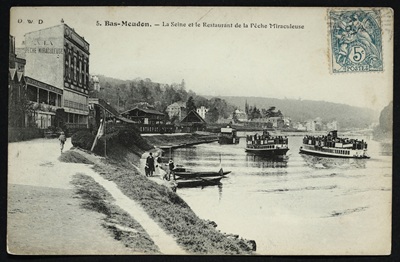
Hemingway wist een goed adresje om friture de petits poissons te eten: La Pêche Miraculeuse (‘De Miraculeuze Visvangst’), een “open-air restaurant built out over the river”, gelegen aan een Seinebocht in Bas Meudon. “It was a place out of a Maupassant story with the view over the river as Sisley had painted it.” Op internet vind je nog een oude foto van dat restaurant, met daarop ook te zien de salonboten waarmee Parijzenaars zich op zon- en feestdagen geheel in stijl lieten vervoeren. La Pêche Miraculeuse oogt als een gewoon restaurant aan de waterkant, maar Hemingways beschrijving doet denken aan het zomerterras van een guinguette, een café(-restaurant) in de banlieue.³ Mogelijk werd er ook muziek gemaakt, accordeonmuziek, want een guinguette was vroeger vaak het toneel van een bal musette.
DG
1 Dace, een voorn; de common dace is de serpeling (Leuciscus leuciscus).
2 Muscadet is een droge, frisse witte wijn uit de westelijke Loirestreek die vaak bij vis en schelpdieren gedronken wordt.
3 Guinguette staat in Van Dale: ‘buitencafé, uitspanning’, en
buitencafé ‘buiten, m.n. in de omgeving v.e. stad gelegen café’.
Referenties
George Orwell, Down and Out in Paris and London, 1933.
Ernest Hemingway, A Moveable Feast, 1964.
Ethel Portnoy, Parijse feesten, 2004, p. 75.
» Een bal musette in Quartet.
» Brasero’s in Liefde en goudvisschen.
» Levend behang in vooroorlogs Parijs.
» “And you mustn’t write slop”.
» index
Geplaatst op 7 mei 2016, het laatst gewijzigd op 24 augustus 2026.
© de 5e Verdieping 2016-2026